
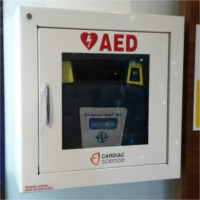
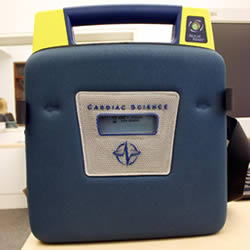
A defibrillator (see images) is kept in The Street outside Reception – in a white, wall-mounted, alarmed box, just right of the sofas.
(This is the property of the University and not the Computer Lab)
Defibrillation is the treatment for cardiac arrest (or heart attack). It consists of delivering a therapeutic dose of electrical energy to the affected heart with a device called a defibrillator, which allows the heart to re-establish its natural rhythm.
Defibrillators can be external, transvenous, or implanted, depending on the type of device used.
Some external units (such as the one in the Computer Lab), known as Automated External Defibrillators (AEDs), automate the diagnosis of treatable rhythms, meaning that lay responders or bystanders are able to use them successfully with little, or in some cases no, training. (It is recommended, where possible, that only a trained First Aider administers this treatment)
Sudden cardiac arrest is a leading cause of death in Europe, affecting about 700,000 individuals a year. Many victims of sudden cardiac arrest can survive if bystanders act immediately while ventricular fibrillation (VF) is still present. Successful resuscitation is unlikely once the rhythm has deteriorated to asystole.
The Resuscitation Council (UK) strongly recommends a policy of early attempted defibrillation.
Literature
- The use of Automated External Defibrillators, Resuscitation Council (UK) – guidelines for the use of AEDs by laypeople out of hospital